Vision-Language-Action (VLA) Models: A Review of Recent Progress
Table of Contents
I am new to this field — feel free to discuss and bring up any questions!
This post is adapted from my slides.
Background and Concepts
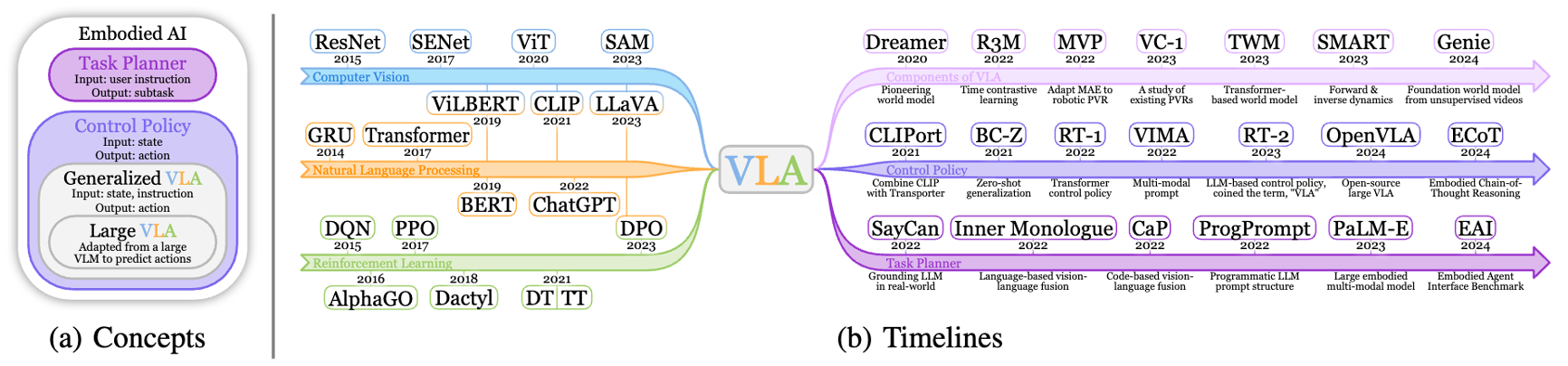
The Concept of Vision-Language-Action (VLA) Models
In my understanding, Vision-Language-Action (VLA) models1 are multimodal foundation models for embodied AI. They take vision (e.g., observations in video streams) and language (e.g., user instructions) as inputs, and generate low-level robot actions (i.e., the control policy) as outputs. A VLA uses a vision-language model (VLM) for vision-and-language-conditioned action generation.
Add VLM-Based Task Planners for Long-Horizon Tasks
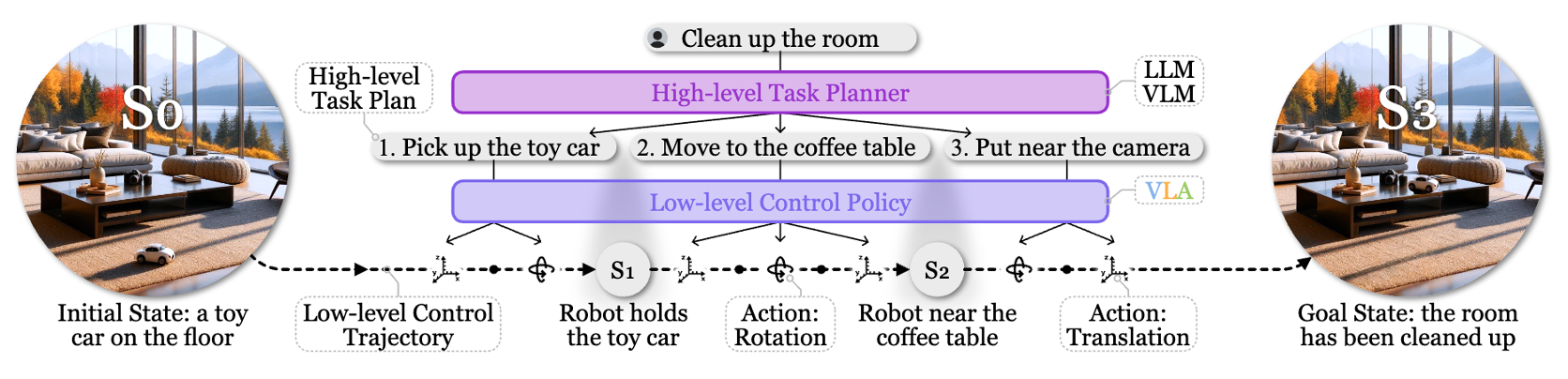
Early VLAs focus on low-level robot control, which alone is insufficient for complex, long-horizon tasks unless the entire task is trained end to end. One approach is to add an LLM/VLM-based task planner that decomposes a long-horizon task into simpler subtasks for the VLA to complete in sequence. Earlier work usually uses a separate model as the task planner, while recent work shares one VLM backbone between task planning and control (i.e., a dual-system design).
Recent VLA Progress
I summarize recent VLA progress along two axes: from system-1-only (control) to dual-system (planning + control), and from discrete actions to continuous actions. This gives four quadrants:
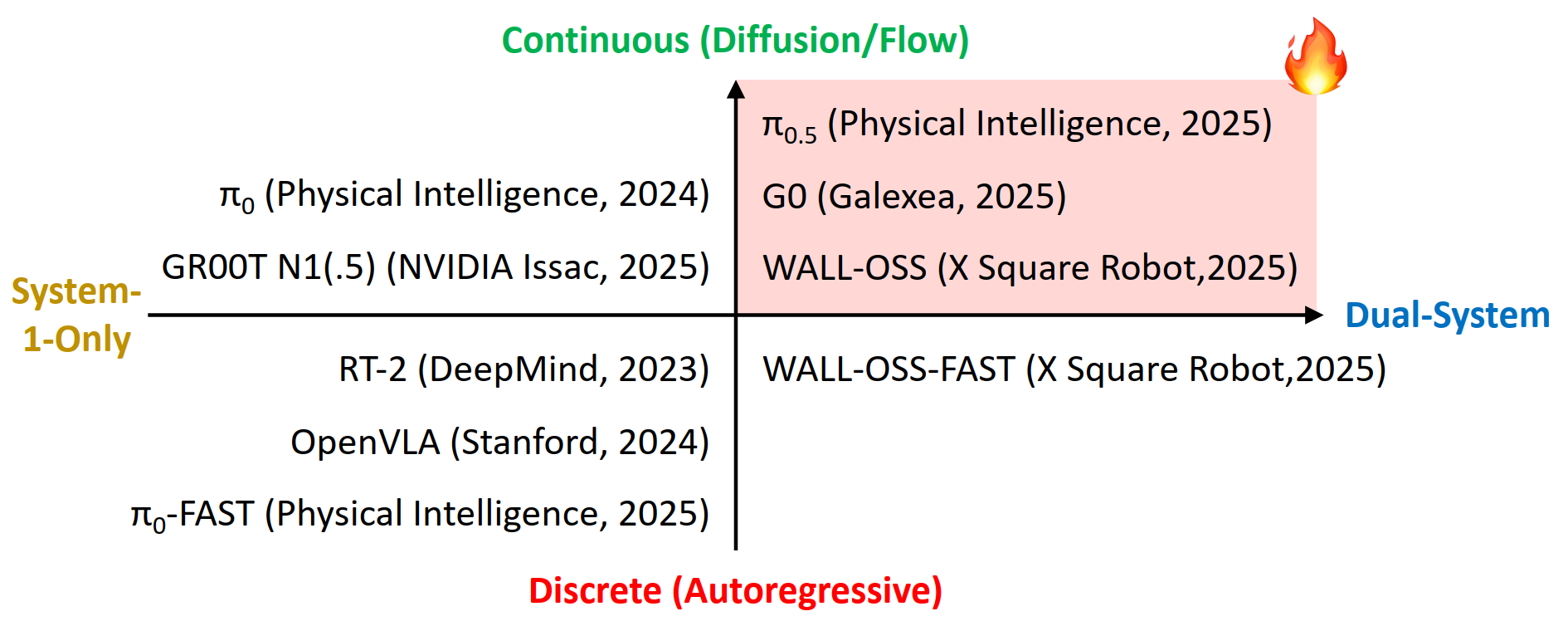
The following sections introduce these categories in turn.
Discrete VLA
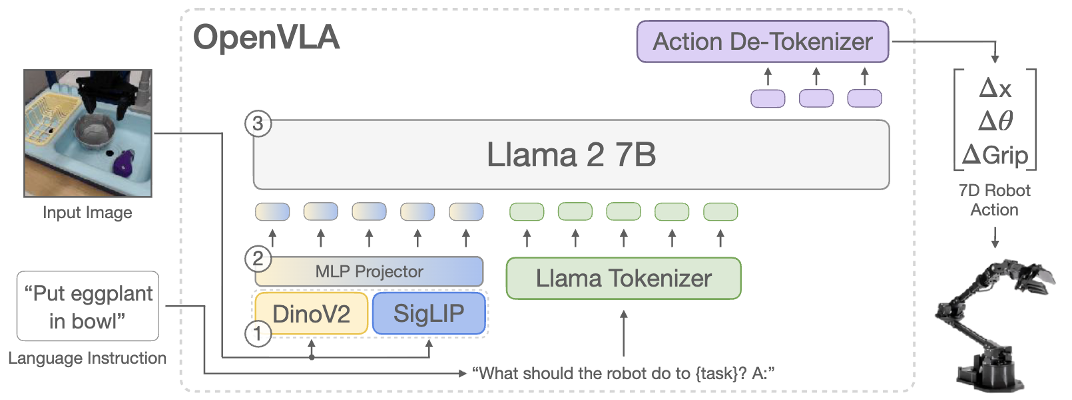
A discrete VLA generates discrete action tokens. It maps low-level robot actions to discrete tokens, then trains the VLM to generate them autoregressively, much like text tokens. This gives action and language a common representation and extends next-token prediction to next-action prediction. However, autoregressive generation can introduce high latency and low control frequency because each new action token requires another pass through the VLA.
Some representative methods:
- RT-22 (ViT + PaLI-X/PaLM-E): pioneering work that introduced and popularized the term “VLA.”
- OpenVLA3 (DINOv2 & SigLIP + Llama 2 7B): an influential open-source VLA model (3.8k stars on GitHub).
- FAST4: an action tokenizer that compresses action sequences with DCT (Discrete Cosine Transform).
Continuous VLA
A continuous VLA samples from a continuous action space. This allows smoother, higher-precision control, but is harder to train on top of existing language models. Physical Intelligence addressed this by adding a flow-matching action expert to a pretrained VLM, and trained $\pi_0$5 on top of a pretrained PaliGemma 2B VLM.
The pretrained VLM provides semantic understanding and generalization from internet-scale data, while the flow-matching action expert learns high-frequency (up to 50 Hz) control from cross-embodiment data. The model can then be fine-tuned for difficult or unseen tasks.
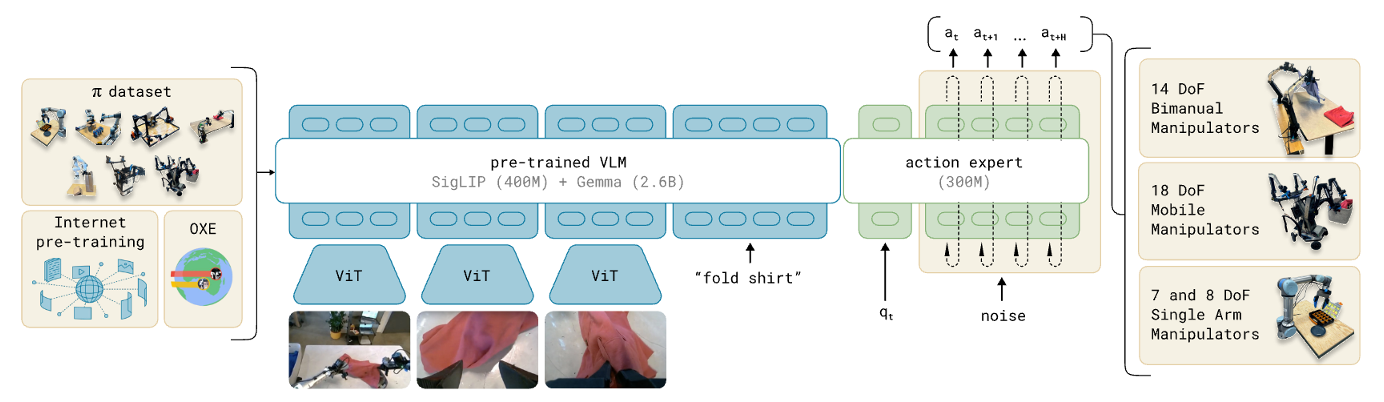
Similarly, NVIDIA Isaac trained GR00T N1(.5)6, which combines a pretrained Eagle-2 VLM with a diffusion-based action head as a foundation model for generalist humanoid robots. In both $\pi_0$ and GR00T, the VLM backbone and action expert communicate through attention modules, conditioning generated actions on the VLM hidden states (i.e., KV). There are two technical differences:
- Attention mechanism: $\pi_0$ concatenates the VL and action KV and conducts masked self-attention (a blog illustrates this clearly); GR00T directly conducts cross-attention between the two parts.
- Number of VLM layers involved: $\pi_0$ aligns the number of layers in the action expert to the VLM backbone, and conducts self-attention in each layer (MoE-like); GR00T only keeps the hidden states of the last layer in the VLM7, and conducts cross-attention with it for each layer.
Dual-System VLA
Rather than pairing a system-1 VLA with a separate LLM/VLM task planner, a dual-system VLA also uses its VLM backbone for planning. System 2 (high-level planning) and system 1 (low-level control) therefore share one VLM. The VLA learns to predict subtasks directly from user instructions, improving open-world generalization while using fewer resources than a separate planner model.
Question: does sharing a VLM improve performance by aligning systems 1 and 2? On the other hand, could their objectives interfere with each other?
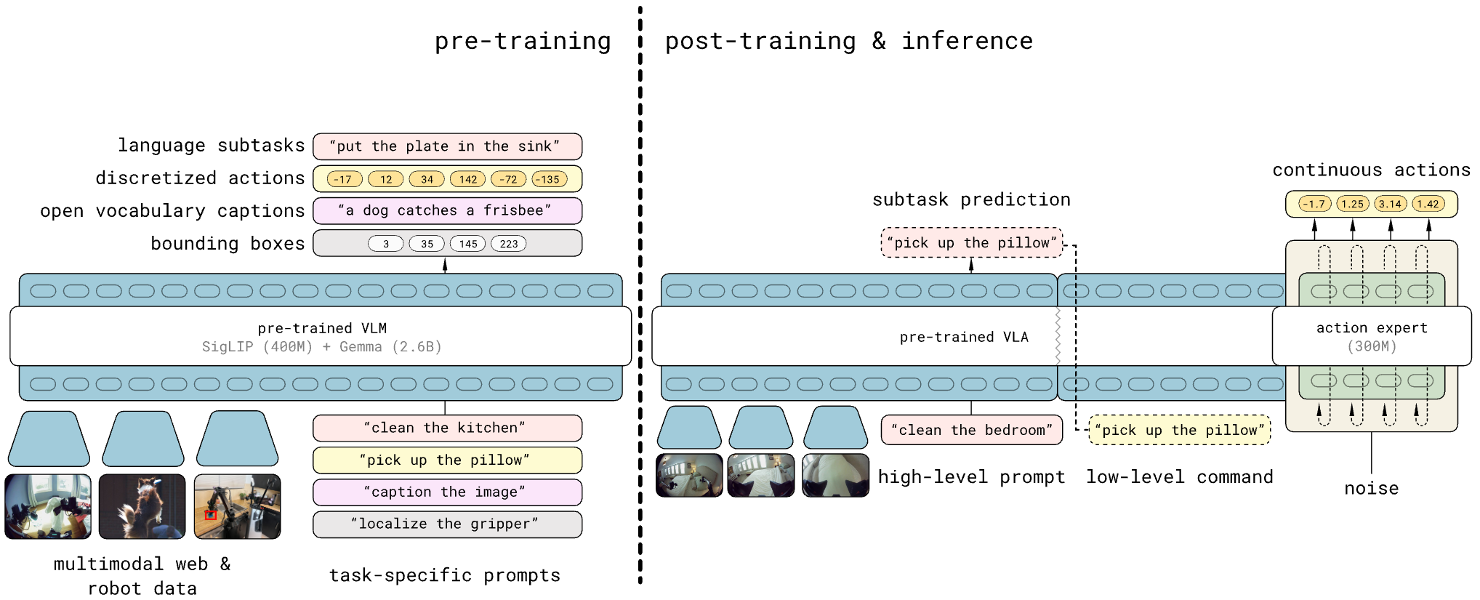
$\pi_{0.5}$8, trained by Physical Intelligence, is the first model in this category. Compared with $\pi_0$, its training data also includes object detection, instructions, subtask commands, and discrete actions. At inference time, its VLM first predicts a subtask from the high-level prompt (system 2), then the VLM and action expert execute that subtask (system 1). Recent VLAs such as Galaxea’s G09 and X Square Robot’s WALL-OSS10 follow this training recipe and inference scheme. While most of these models are continuous VLAs, WALL-OSS also includes a discrete version with FAST tokenization (WALL-OSS-FAST).
Their repositories and open-source status:
- $\pi_{0.5}$: Weights are available, and part of the code is released at Physical-Intelligence/openpi. The VLM subtask-prediction inference code is not available.
- G0: Weights and the open-world dataset are available, and part of the code is released at OpenGalaxea/G0. It currently supports only real-robot inference.
- WALL-OSS: Weights and code are available at X-Square-Robot/wall-x.
Summary and Outlook
Since RT-2 appeared in 2023, VLAs have rapidly evolved from discrete to continuous control, and from single-system to dual-system designs. I expect native multitasking to become another trend: embodied agents should handle fundamentally different tasks (e.g., chat, memory, and navigation) rather than being restricted to actions. Recent models already share an internet-scale pretrained VLM backbone between task planning and control. Although both are still action-oriented, this provides a foundation for sharing one VLM across a broader set of tasks.
I am currently working on this multi-expert foundation model for native multitasking in embodied agents — feel free to contact me for discussion and collaboration!
Yueen Ma et al., “A Survey on Vision-Language-Action Models for Embodied AI”, arXiv, 2024.
Brianna Zitkovich et al., “RT-2: Vision-Language-Action Models Transfer Web Knowledge to Robotic Control”, CoRL, 2023.
Moo Jin Kim et al., “OpenVLA: An Open-Source Vision-Language-Action Model”, CoRL, 2024.
Karl Pertsch et al., “FAST: Efficient Action Tokenization for Vision-Language-Action Models”, RSS, 2025.
Kevin Black et al., “$\pi_0$: A Vision-Language-Action Flow Model for General Robot Control”, RSS, 2025.
Johan Bjorck et al., “GR00T N1: An Open Foundation Model for Generalist Humanoid Robots”, arXiv, 2025.
Specifically, the language backbone of the VLM in GR00T N1.5 is fine-tuned from the first 14 layers of the pre-trained Qwen3-1.7B (28 layers in total), according to my test of similarity between the weights.
Physical Intelligence et al., “$\pi_{0.5}$: A Vision-Language-Action Model with Open-World Generalization”, arXiv, 2025.
Tao Jiang et al., “Galaxea Open-World Dataset and G0 Dual-System VLA Model”, arXiv, 2025.
X Square Robot, “WALL-OSS: Igniting VLMs toward the Embodied Space”, white paper, 2025.