Making Low-Bit LLMs Actually Fast in Parallel via Vector Table Lookup
Table of Contents
🏆 ACM MobiSys 2026 Best Paper Award Runner-Up
🔗 Paper | Code | Slides | Chinese post (清华AIR公众号)
Today’s ultra-low-bit LLMs (typically below 4 bits per weight) have small memory footprints. For example, the weights of Microsoft’s 2B BitNet model occupy about 0.4 GB1. So they should run fast on a laptop or smartphone, right?
Not automatically. Fewer bits reduce memory footprint, but they only translate into speed when the underlying inference kernel matches the data representation and the workload. Lookup-table (LUT) kernels work well for single-token generation, yet lose much of that advantage when many tokens are processed in parallel. Vec-LUT addresses this parallel access pattern. Across five x86 and ARM devices, it delivers up to 4.2× end-to-end prefilling speedup over baselines at similar bits per weight (BPW); on Snapdragon 8 Elite, its CPU implementation even outperforms the phone’s NPU (llama.cpp’s Hexagon backend) using only two CPU cores.
On-device LLM inference on CPUs
On-device models now power mobile assistants, local agents, and embodied AI systems, where memory remains limited. Quantization research has moved from 8-bit2 to 4-bit3 to 2-bit4, and now to 1.58-bit ternary models, whose weights take values in {-1, 0, 1}, a format popularized by Microsoft’s BitNet5.
Their small weight alphabet also makes lookup-table (LUT)-based inference practical: instead of dequantizing low-bit weights and multiplying them with activations at runtime, a kernel can precompute a small table and replace much of the arithmetic with table lookup. Prior LUT-based systems such as bitnet.cpp6 and T-MAC7 showed that CPUs can be competitive for single-token generation. Vec-LUT asks whether the same idea can remain fast when the workload becomes parallel.
How LUT-based inference works
A major cost in quantized LLM inference is mixed-precision general matrix multiplication (mpGeMM), such as multiplying 1.58-bit weights with INT8 or FP16 activations. Commodity CPUs and many edge accelerators do not natively support these mixed-precision operations, so inference frameworks usually need either dequantization or custom kernels8.
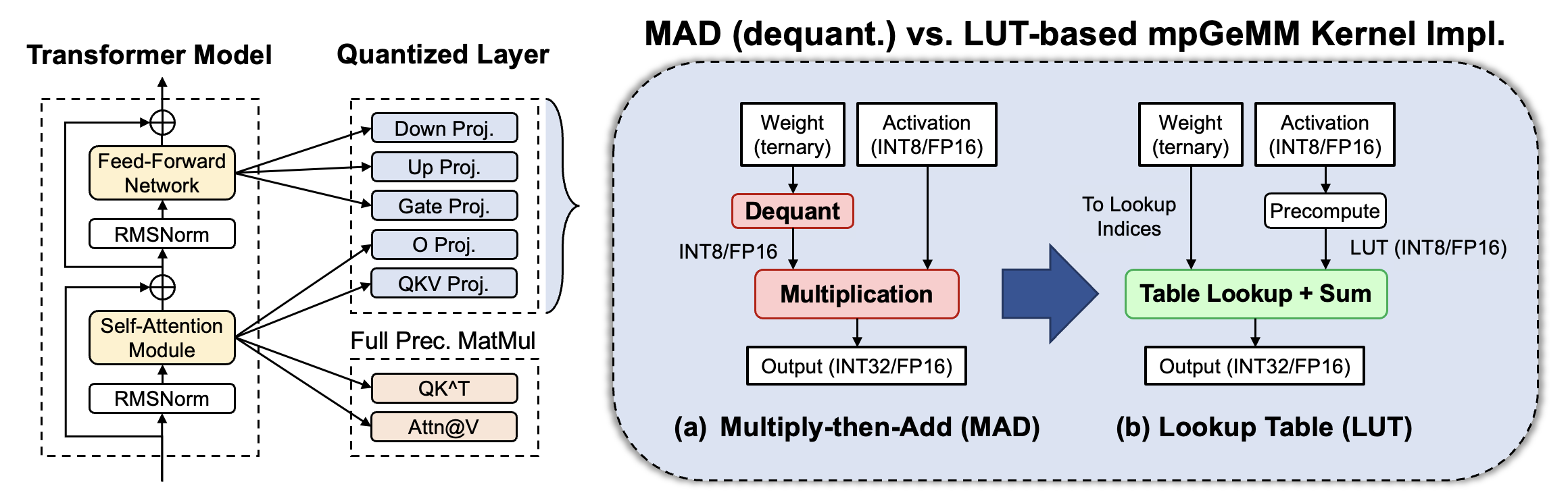
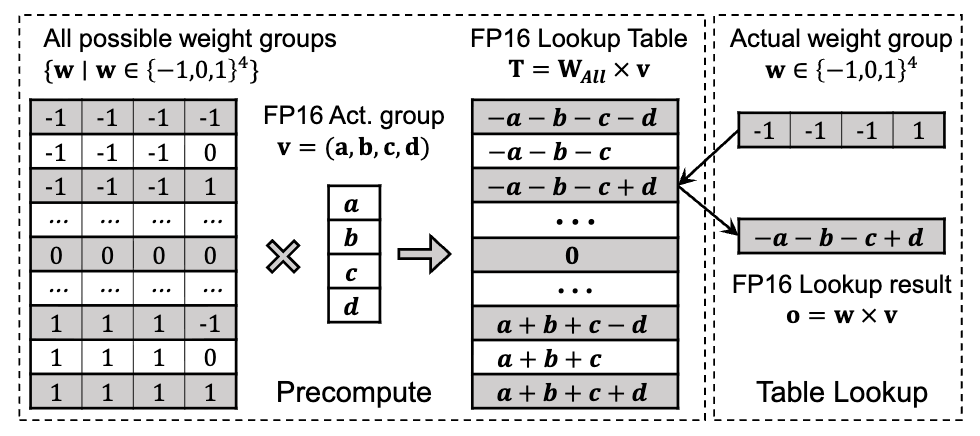
LUT-based inference starts by splitting the weight matrix into small groups. Low-bit weights have very few possible patterns: four ternary weights have only 3^4 = 81 combinations. For a given activation vector, the kernel can precompute every “weight pattern × activation” result and store the results in a table. At runtime, the packed weight group becomes an index into that table, so the kernel can skip dequantization and multiplication for the inner loop and accumulate the looked-up values instead.
Lower bits ≠ faster, in parallel
The catch is parallelism. Existing LUT kernels follow what we call a scalar LUT paradigm: a 1→1 lookup. Each token has its own table, so processing N tokens means building or accessing N tables and doing N separate lookup streams.
For single-token generation, scalar LUT works well because only one table and one lookup stream are involved, allowing existing kernels to use the available memory bandwidth effectively. But parallel inference is common in real workloads: prefilling medium/long prompts9, 10, serving multiple requests11, 12, parallel test-time scaling13, 14, and speculative decoding15, 16 all process many tokens at once. In these cases, scalar LUT loses much of its advantage:
- Memory bandwidth utilization drops below 40%.
- Sometimes it’s slower than not using a LUT at all.
The root cause is memory access. Table lookup is a random, non-contiguous operation. Repeating it over multiple per-token tables, especially when their aggregate working set exceeds cache capacity, spends much of the time moving scattered data rather than doing useful accumulation. In our profiling of a representative scalar-LUT kernel, lookup (including weight loading) accounts for nearly half of the mpGeMM latency.
The breakdown below shows where the time goes in T-MAC’s scalar-LUT mpGeMM kernel, measured on an Orange Pi 5 Plus with a single thread:
GeMM shape (M × K) | Precompute | Lookup | Accumulate | Scale |
|---|---|---|---|---|
320 × 3200 | 0.8% | 47.6% | 25.0% | 26.6% |
128 × 8640 | 0.7% | 47.3% | 25.5% | 26.4% |
For parallel inference, optimizing arithmetic alone cannot remove this lookup-dominated memory bottleneck.
The core idea: look up N at once
The key observation is that lookup indices come from the weights, and the weights are shared across all tokens. The same weight index applies to every token in the parallel group, so independent per-token lookups are unnecessary.
Vec-LUT changes the lookup unit from a scalar to a vector. Instead of one table per token, it builds a single unified table across all parallel tokens. Each table entry stores not one scalar result, but a vector of results, one per token. A weight index now triggers one 1→N lookup that fetches the results for the whole token group.
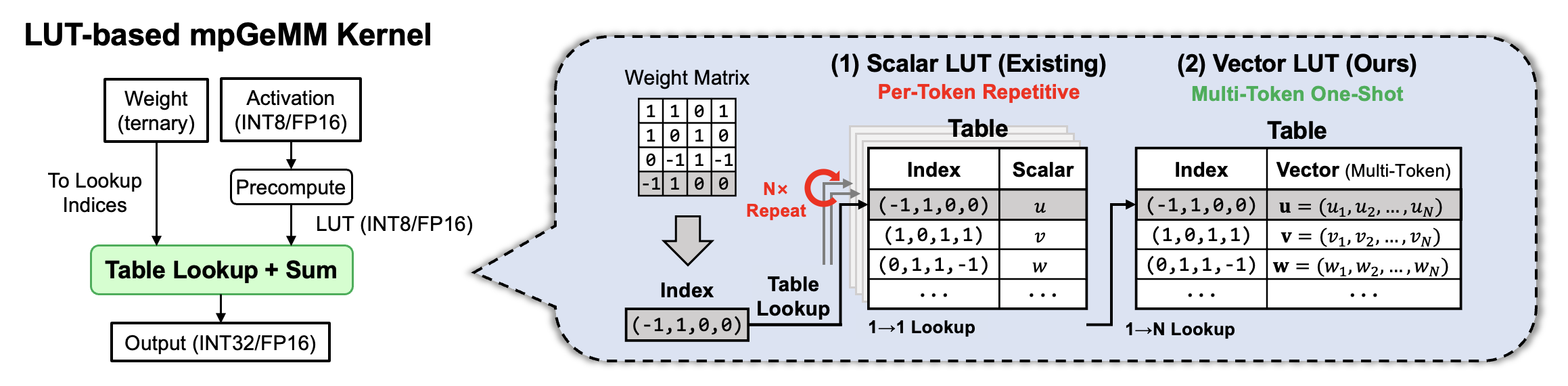
The resulting access pattern has three useful properties:
- N independent lookup passes become one vector lookup pass per weight index.
- Random scattered lookups become contiguous vector reads, followed by vector accumulation.
- The kernel no longer depends on hardware lookup instructions such as ARM
TBLor x86PSHUF, making it less tied to a specific ISA.
In our latency breakdown, the lookup share drops from T-MAC’s 47% to under 1%.
Making vector LUT practical
Two engineering details determine whether vector LUT is fast in practice.
-
Tensor layout. A unified table only helps if the surrounding tensors follow compatible layouts. A mismatched layout can make the kernel up to 12× slower. Our Vector LUT-Centric Tensor Layout stores activations, tables, and outputs in token-contiguous form, and packed weights in tile-contiguous form. It performs weight reordering offline and fuses the runtime activation/output transformations into the kernel to minimize overhead.
-
Cache locality. Vector LUT increases the table size by N×. At a sequence length of 512, one 2-bit, INT16 vector table for a Llama3 8B GeMM would exceed 280 MiB, far beyond the cache capacity of edge CPUs. Our Cache-Aware Streamed Lookup slices the precompute-and-lookup pipeline into cache-sized tiles and streams through them, so most LUT work stays in on-chip cache instead of repeatedly touching a large random-access table.
Dropping hardware lookup instructions also relaxes bit-width and shape constraints. That lets us use flexible sub-2-bit packing: our I1 packing reaches 1.60 bits per weight, while supporting a broad range of weight shapes. Additional optimizations, including topological precomputation and INT16–INT32 hierarchical accumulation, reduce the remaining overhead.
Results: 5 devices × 3 models
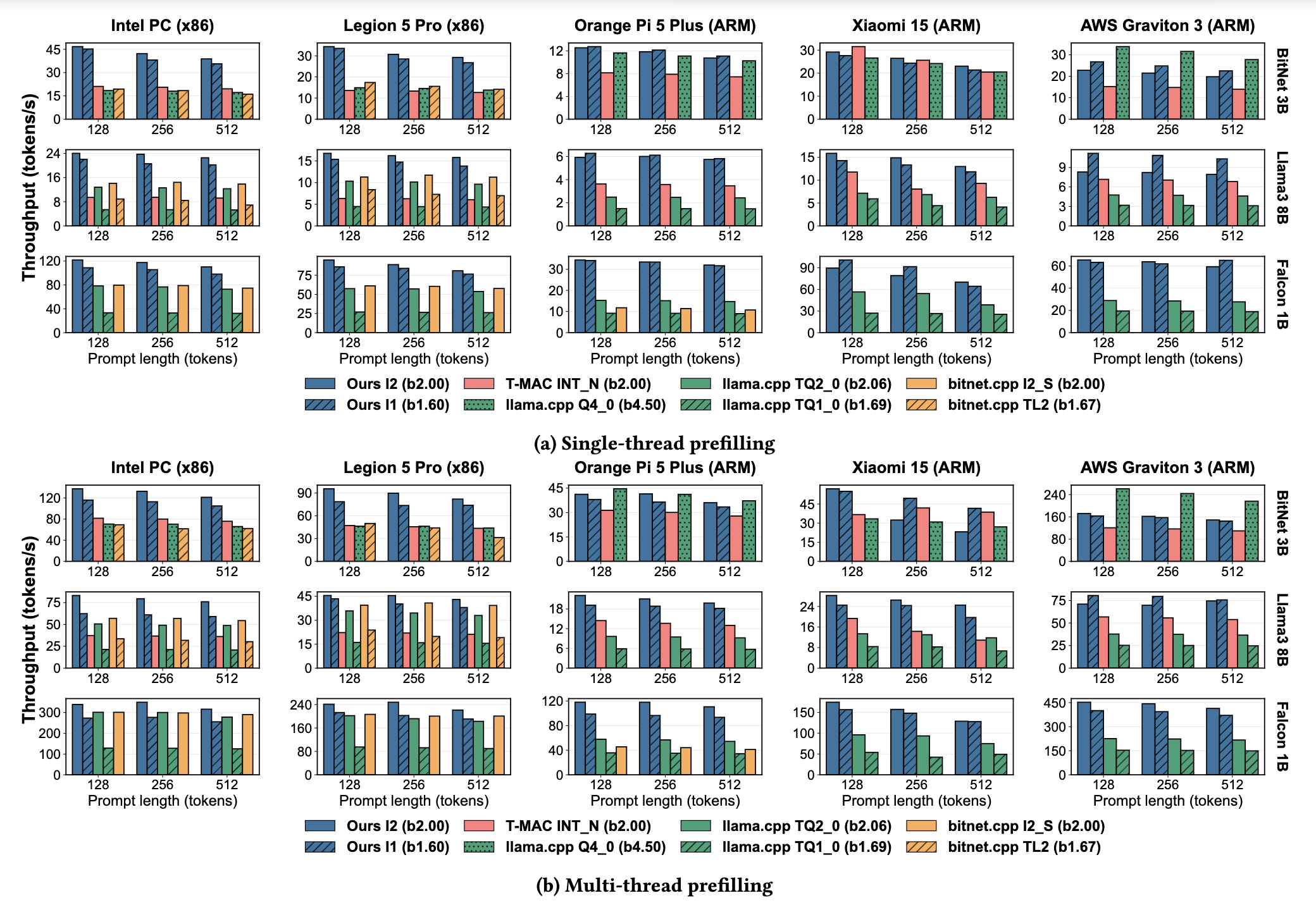
We evaluated Vec-LUT across five x86/ARM devices (PC, laptop, SBC, smartphone, and CPU server) and three ternary LLMs: Falcon3 1B, HF BitNet 3B, and Llama3 8B.
- End-to-end prefilling: up to 4.2× speedup with
I1(1.60 BPW) and 2.6× withI2(2.00 BPW) over baselines with similar BPWs. - CPU vs. NPU: on Snapdragon 8 Elite, Vec-LUT
I2reaches 1.05–1.12× the throughput of llama.cpp’s Q4_0 Hexagon NPU backend for Llama3 8B prefilling, using only 2 CPU cores. - Continuous batching: on an 8-core, $0.50/h AWS Graviton 3 server, Vec-LUT
I2serves Falcon3 1B at 273.5 tokens/s across 32 parallel requests, 1.4× faster than llama.cppTQ2_0. - Energy efficiency: up to 2.1× better tokens/Joule than llama.cpp and 1.8× better than T-MAC.
Implementation and scope
Our implementation, vlut.cpp, is a lightweight extension of llama.cpp. It targets mainstream x86 and ARM CPUs, follows a familiar llama.cpp-style build and usage flow, and is released as part of the open-source OpenBitSys project.
Vec-LUT is most useful when a ternary checkpoint is available (e.g., obtained via quantization-aware training), the workload includes substantial parallel inference (prefilling, batching, speculative decoding, or parallel test-time scaling), and CPU memory use and throughput are the main constraints.
Once Vec-LUT reduces lookup cost to below 1%, vector addition (accumulating the looked-up results) becomes the dominant cost. It takes about 65% of end-to-end prefilling latency in the measured HF BitNet 3B workload, making it a natural target for future vector-LUT-centric accelerators.
Our team is hiring postdocs and interns (physical-AI foundation models, LLM training/inference systems, and more). Feel free to contact Prof. Ting Cao.
Shuming Ma et al., “BitNet b1.58 2B4T Technical Report”, arXiv, 2025.
Tim Dettmers et al., “LLM.int8(): 8-bit Matrix Multiplication for Transformers at Scale”, NeurIPS, 2022.
Elias Frantar et al., “GPTQ: Accurate Post-Training Quantization for Generative Pre-trained Transformers”, ICLR, 2023.
Mengzhao Chen et al., “EfficientQAT: Efficient Quantization-Aware Training for Large Language Models”, ACL, 2025.
Shuming Ma et al., “The Era of 1-bit LLMs: All Large Language Models are in 1.58 Bits”, arXiv, 2024.
Jinheng Wang et al., “bitnet.cpp: Efficient Edge Inference for Ternary LLMs”, ACL, 2025.
Jianyu Wei et al., “T-MAC: CPU Renaissance via Table Lookup for Low-Bit LLM Deployment on Edge”, EuroSys, 2025.
Shijie Cao, Lingxiao Ma, and Ting Cao, “Advances to low-bit quantization enable LLMs on edge devices”, Microsoft Research Blog, 2025.
Hao Wen et al., “AutoDroid: LLM-powered Task Automation in Android”, MobiCom, 2024.
Leming Shen et al., “AutoIOT: LLM-Driven Automated Natural Language Programming for AIoT Applications”, MobiCom, 2025.
Zheyu Shen et al., “EdgeLoRA: An Efficient Multi-Tenant LLM Serving System on Edge Devices”, MobiSys, 2025.
Borui Li et al., “MobiLoRA: Accelerating LoRA-Based LLM Inference on Mobile Devices via Context-Aware KV Cache Optimization”, ACL, 2025.
Mouxiang Chen et al., “Parallel Scaling Law for Language Models”, NeurIPS, 2025.
Ryan Ehrlich et al., “CodeMonkeys: Scaling Test-Time Compute for Software Engineering”, arXiv, 2025.
Yaniv Leviathan et al., “Fast Inference from Transformers via Speculative Decoding”, ICML, 2023.
Charlie Chen et al., “Accelerating Large Language Model Decoding with Speculative Sampling”, arXiv, 2023.