A Unified KV Cache for Multi-Task Inference on Robots
Table of Contents
🔗 Paper | Code | Project Page
A useful robot has to do more than act. While its arms are moving, it should be narrating progress to the user, writing down what changed in the scene, maybe replanning the next subtask. Recent Mixture-of-Transformers (MoT) Vision-Language-Action Models (VLAs) such as π0.51 are a step in this direction: one shared backbone, separate experts for actions and language, so the model can in principle act and talk at the same time.
In practice, on the single GPU a robot actually carries, the two outputs wait in line for each other. We traced the problem to something unglamorous: every task manages its own KV cache. OxyGen is our fix: treat the KV cache as one shared resource across tasks and control frames. On an RTX 4090 it sustains over 200 tokens/s of language generation while holding a 70 Hz action frequency2 (27 Hz on a Jetson AGX Thor), with up to 3.7× end-to-end speedup over the isolated execution that existing systems use.
VLAs that act and talk
Continuous VLAs such as π03 attach a lightweight flow-matching head to a VLM backbone: the backbone consumes the observation and instruction once per control frame, and the head denoises an action chunk from that context. MoT VLAs4 take the idea one step further. The backbone is shared, but each output modality gets its own expert weights, so a single checkpoint can emit both action chunks and free-form language.
On paper, inference factorizes neatly. At every control frame, the shared backbone prefills the observation into a single KV cache, and that cache is modality-agnostic: it encodes what the robot just saw and was told, without committing to any particular output. Any expert can read from it:
- the action expert runs
Sflow-matching denoise steps over that cache and emits a chunk ofHactions (S = 10, H = 10throughout, as in openpi’s π0.5-LIBERO configuration); - the language expert decodes up to
Ntokens autoregressively from the same cache: subtasks, narration, memory.
The two tasks live under very different deadlines. Actions are due within the frame: dexterous manipulation wants on the order of 50 Hz, and a late chunk means jerky motion or a stalled robot. Language is soft: a memory sentence arriving a second late is still useful. Any efficient design has to exploit that asymmetry rather than fight it.
Why running both tasks crawls
The architecture is ready for all of this: one prefill, two experts reading one cache. The serving stack is not. The standard approach in openpi5 and every other MoT serving setup we know is what we call isolated execution6: each task triggers its own forward pass of the same model, so the language path re-encodes the same observation and builds its own KV cache from scratch, even though the model would happily share one. This costs you in two ways.
Redundant computation. The shared observation gets encoded once per task, producing byte-identical KV cache entries. That duplicate is not cheap: on an RTX 4090, one prefix forward through the VLM backbone takes ~45 ms, about 2.2× the ~20 ms the entire denoise loop costs7. For short language outputs, the duplicate prefill alone accounts for a 1.4× slowdown.
Resource contention. Sharing the cache naively doesn’t fix the schedule. Run the two tasks sequentially in one process and language decoding blocks the control loop: as language outputs grow long, baseline action frequency falls from 49.9 Hz to 19.1 Hz, a 2.6× loss8. Run them as separate processes sharing the GPU via MPS and you nearly double peak memory while saving very little.
“Isn’t this just prefix caching and continuous batching?” is the natural question, and LLM servers9, 10 do both well. But their world is homogeneous: one kind of cache reader, one kind of request, no deadlines. A MoT VLA is heterogeneous on both axes:
- Heterogeneous cache access. The action expert consumes the prefix as read-only context on every denoise step; the language expert appends a new KV entry per decoded token. Prefix caching assumes a single autoregressive reader path, and a standard server has no semantics for coordinating two experts with different access rules on the same cache.
- Heterogeneous timing. Language decoding must advance by a bounded budget per control frame, pause, and resume next frame without recomputation, because the action deadline comes back every frame. Continuous batching runs each request to completion; nothing in a standard server knows what a robot control frame is.
One cache, shared across tasks and frames
OxyGen’s answer is to make the KV cache a first-class shared resource, managed by one cache manager across tasks and time, with one mechanism for each of the gaps above.
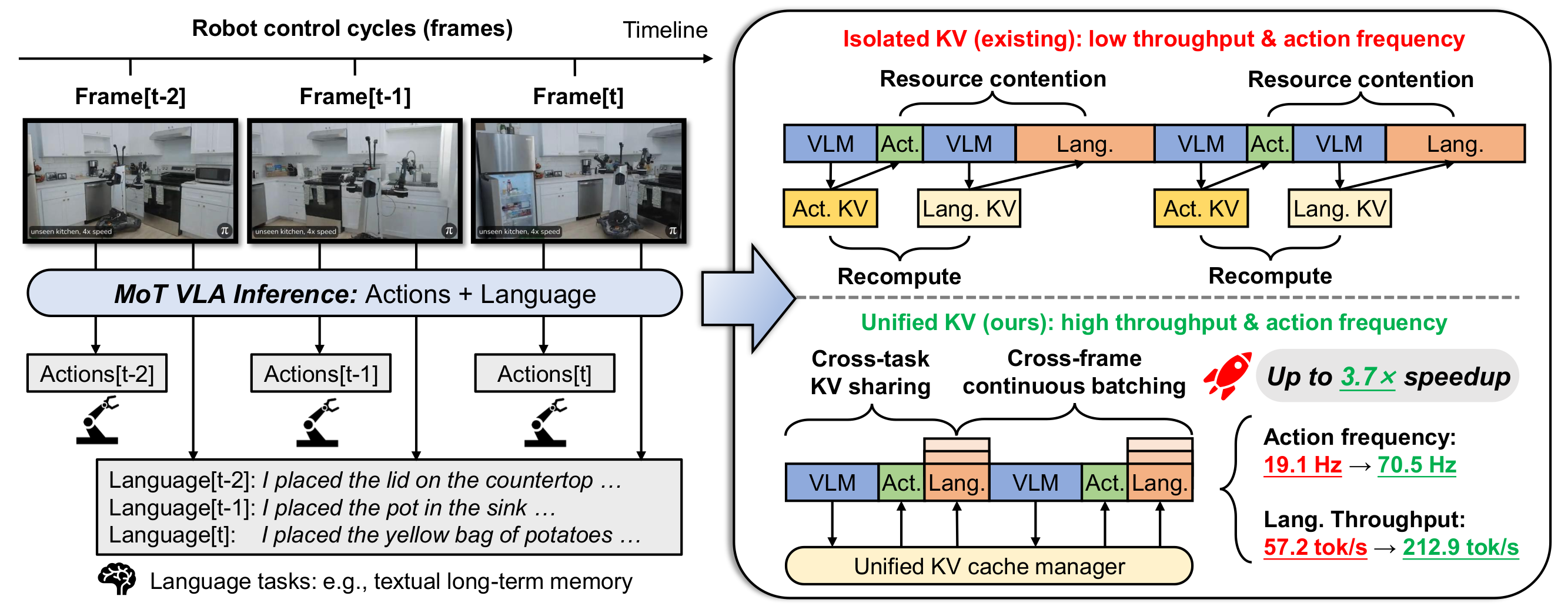
Cross-task KV sharing. Each frame, the backbone prefills the new observation once. The manager fans the resulting cache out to the action expert as a read-only view, and to a freshly initialized language request that starts its autoregressive suffix from the same prefix. The duplicate prefill simply disappears, which is why the gain is largest exactly when language outputs are short.
Cross-frame continuous batching. Every language request is a resumable state: its own KV cache, its token buffer, a done flag. At each frame, the manager collects all unfinished requests, batches them into a single decoding forward, advances each by up to k tokens, evicts the finished ones, and persists the rest for the next frame. In steady state, with N-token requests advancing k tokens per frame, about N/k requests are in flight and one forward pass serves them all, exactly the hardware parallelism that isolated execution leaves on the table.
The budget k caps how far each request advances per frame; anything unfinished resumes in the next, so language never holds the action deadline hostage, and even the longest requests we test finish within about a second. The two mechanisms are standard pieces. What makes them work together is the cache semantics in between: read-only denoising reads alongside append-only decoding, coordinated under a deadline that recurs every few dozen milliseconds.
Results: from an RTX 4090 to a Jetson Thor
We evaluated π0.5 across LIBERO11, DROID12, and ALOHA13 configurations on an RTX 4090 and a Jetson AGX Thor, one new observation and one new language request per frame, sweeping N and k.
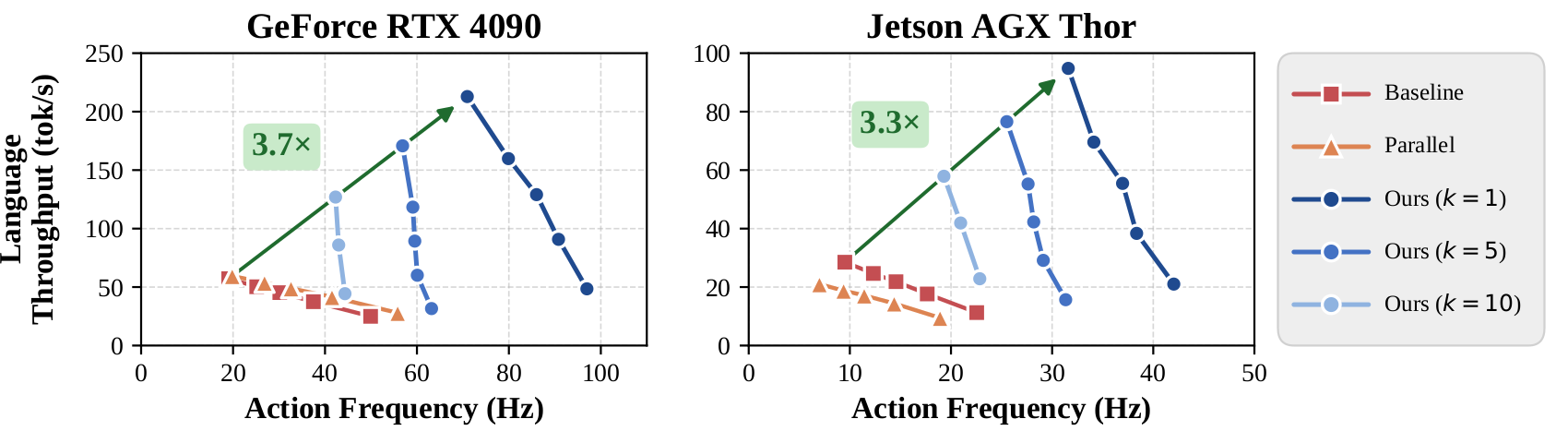
The tradeoff plot is the headline: every isolated-execution curve has to give up action frequency to buy language throughput (or vice versa) as the language workload grows. OxyGen expands the frontier instead, improving both axes by 1.2–3.7×. Beyond the one-request-per-frame default, we swept arrival patterns (uniform bursts, Poisson arrivals, random request lengths), and the picture is the same; naive MPS parallelization, by comparison, buys very little.
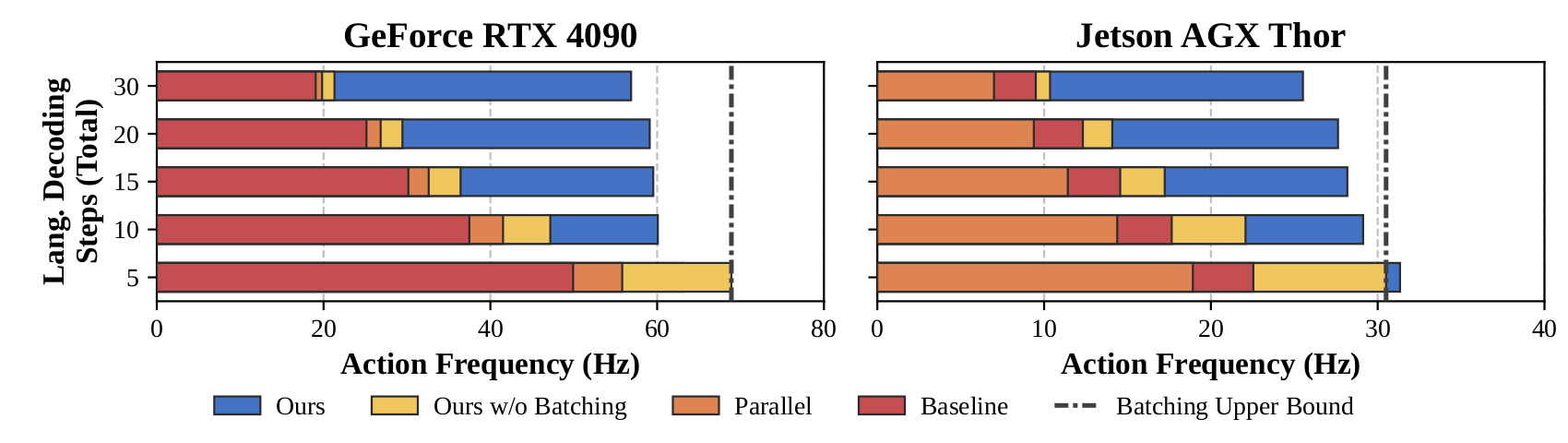
The ablation separates the two mechanisms. KV sharing alone (Ours w/o Batching) cuts mean end-to-end latency from 200.3 to 145.4 ms at N=5 (a 1.38× speedup) and shaves 25.5–36.4% off profiled inference latency across N=1–5. Cross-frame batching then takes over as outputs lengthen: with both enabled at k = 5, action frequency stays near 60 Hz on the RTX 4090 and 27 Hz on the Jetson even at N=30, while the baseline degrades 2.6×.
We also checked everything besides speed, and nothing regressed: with the official π0.5-LIBERO checkpoint, success rates stay within ±0.8% of openpi’s reported numbers (a 10-seed rerun, 20,000 rollouts, lands at 96.76% overall [96.55, 96.97] against openpi’s 96.85%); memory grows by only 15%, while average power drops by up to 47% and energy per request by up to 78%. Less redundant work means fewer weight reads. MPS parallelization moves the wrong way on every count: nearly double the peak memory, slightly more energy per request.
The deployment we care most about is a real humanoid robot with the Jetson AGX Thor on board, 3-way 224×224 cameras, N=30, k=5, running manipulation interleaved with language generation. Each frame has a 333 ms action-execution window, and the measured breakdown fills in the rest:
| Stage | Baseline (ms) | OxyGen (ms) |
|---|---|---|
| Prefill & denoise | 207.5 | 198.0 |
| Language generation | 822.3 | 195.4 |
| Action execution window | 333.0 | 333.0 |
The baseline’s 1,030 ms of per-frame inference far exceeds the window, so the control loop cannot keep up at all. OxyGen brings total inference to 393 ms; more importantly, the action-critical prefill-plus-denoise stage takes 198 ms and fits inside the execution window, while language generation (822.3 → 195.4 ms, a 4.2× cut) runs after the action is emitted and hides behind execution.
Beyond a single backbone
We also ported OxyGen to two more open MoT VLAs14, 15 and repeated the measurements on their native implementations: the speedups transfer, and they grow with the language backlog. Same RTX 4090, one new request per frame, N=30:
| Model | Baseline latency | Speedup (k=1) | Speedup (k=5) |
|---|---|---|---|
| Xiaomi-Robotics-0 (4.7B) | 1,540.9 ms | 5.50× | 3.14× |
| StarVLA Qwen3VL-PI_v3 (5.07B) | 1,351.5 ms | 6.18× | 3.41× |
One edge case is worth flagging: when N=k, each request finishes in its arrival frame, the average batch is one, and results sit near break-even (0.92–1.07×). Cross-frame batching pays only when there is a backlog to batch; KV sharing alone is what keeps those points above water.
To see how far the sharing itself scales, we used StarVLA’s released action heads (a flow-matching PI_v3 head, a GR00T flow head, an OFT one-shot head), all reusing one shared Qwen3-VL-4B prefix. More experts means more readers amortizing the same prefill:
Experts E | Speedup (N=5, k=5) | Speedup (N=30, k=5) |
|---|---|---|
| 2 | 1.07× | 3.41× |
| 3 | 1.21× | 3.32× |
| 4 | 1.36× | 3.48× |
For backbone scale, we swept StarVLA’s Qwen3.5 multimodal backbones plus a tensor-parallel run over PCIe: the speedup barely moves.
| Backbone | Baseline latency | Speedup (N=30, k=5) |
|---|---|---|
| Qwen3.5-0.8B | 1,257.5 ms | 3.53× |
| Qwen3.5-2B | 1,267.5 ms | 3.44× |
| Qwen3.5-4B | 1,728.0 ms | 3.60× |
| Qwen3.5-9B | 1,725.9 ms | 3.50× |
| Qwen3.5-9B, TP=2 | 1,983.5 ms | 3.71× |
One caveat: the extra heads were trained separately, so these experiments validate system-level scaling and shared-prefix fan-out, not the quality of a jointly trained multi-expert policy.
Demo: a VLA that remembers what it just did
The point of all that language throughput is not narration for its own sake. It is memory: long-horizon tasks drift unless something records what has been done, which is the motivation behind PI’s MEM16. The public π0.5 checkpoint cannot produce such text out of the box, so after submitting the paper we trained a small addition that can: a suffix-only LoRA17 on the frozen model that appends one observation-grounded line (“The alphabet soup is in the basket.”) after the shared prefix as a private Memory: continuation. It never touches the shared cache or the action path (zeroing it leaves actions bit-identical), and it adds a median 8.16 ms per memory at serving time, against the 47.66 ms prefix forward that isolated execution would recompute.
We supervised it with annotations derived from the raw LIBERO demonstrations; the dataset and adapter are on Hugging Face, and on held-out frames the model reproduces the annotation exactly 87.25% of the time. That is the workload in the demo video at the top of this post: one new memory request per action replan, unfinished ones resuming in the next frame’s language batch, action frequency never noticing.
Scope and what’s next
OxyGen does not try to be everything. The per-frame budget k is fixed per deployment rather than recomputed at runtime; multi-node serving is untested, with the tensor-parallel check covering two GPUs within one node; and the system is a scheduling layer over the model, orthogonal to action-side async pipelines18, 19 and to compression or pruning. What we would like next: more backbones, richer jointly-trained expert sets, and speculative decoding hooked onto the resumable language state, where it should compose cleanly.
Code (JAX and PyTorch backends), the textual-memory adapter, and the annotation dataset are all public; pointers are in the links above. If you’re deploying MoT VLAs under real-time constraints, we’d love to hear what your workload looks like: open an issue or email me.
Our team is hiring postdocs and interns (physical-AI foundation models, LLM training/inference systems, and more). Feel free to contact Prof. Ting Cao.
Physical Intelligence, Kevin Black et al., “π0.5: A Vision-Language-Action Model with Open-World Generalization”, arXiv, 2025.
Action frequency counts emitted actions (H = 10 per chunk, so f = H / T for per-frame latency T); the 70 Hz figure is measured at N = 30, k = 1 on the RTX 4090. S = 10 is openpi’s denoising default (pi0.py:222); H = 10 follows openpi’s π0.5-LIBERO configuration (config.py:744).
Kevin Black et al., “π0: A Vision-Language-Action Flow Model for General Robot Control”, arXiv, 2024.
Weizhuang Liang et al., “Mixture-of-Transformers: A Sparse and Scalable Architecture for Multi-Modal Foundation Models”, arXiv, 2024.
Physical Intelligence, “openpi”, GitHub.
openpi does not release the π0.5 language-generation path; our baseline follows the community reproduction.
Profiled on π0.5-LIBERO (S = 10, RTX 4090): prefix forward ~45.1 ms, full 10-step denoise loop ~20.4 ms.
π0.5-LIBERO on the RTX 4090, k = 5, as the per-request decoding length N grows from 5 to 30.
Woosuk Kwon et al., “Efficient Memory Management for Large Language Model Serving with PagedAttention”, SOSP, 2023.
Lianmin Zheng et al., “SGLang: Efficient Execution of Structured Language Model Programs”, NeurIPS, 2024.
Bo Liu et al., “LIBERO: Benchmarking Knowledge Transfer for Lifelong Robot Learning”, NeurIPS, 2023.
Alexander Khazatsky et al., “DROID: A Large-Scale In-The-Wild Robot Manipulation Dataset”, arXiv, 2024.
Tony Z. Zhao et al., “Learning Fine-Grained Bimanual Manipulation with Low-Cost Hardware”, arXiv, 2023.
Xiaomi Robotics, “Xiaomi-Robotics-0: An Open-Sourced Vision-Language-Action Model with Real-Time Execution”, GitHub.
starVLA Team, “starVLA”, GitHub.
Mateo Torne et al., “MEM: Multi-scale Embodied Memory for Vision Language Action Models”, Technical Report, Physical Intelligence, 2025.
Edward J. Hu et al., “LoRA: Low-Rank Adaptation of Large Language Models”, ICLR, 2022.
Kevin Black, Mark Y. Galliker, and Sergey Levine, “Real-Time Execution of Action Chunking Flow Policies”, arXiv, 2025.
Yiran Zhao et al., “VLA-RAIL: A Real-Time Asynchronous Inference Linker for VLA Models and Robots”, arXiv, 2025.